- Green Digest
- Posts
- What's Happening in Sustainability & ESG (17.03 - 23.03) 🌎
What's Happening in Sustainability & ESG (17.03 - 23.03) 🌎
EU ETS tweaks incoming...

Green Digest
March 24, 2026

This week’s read time: 8 minutes
Welcome to this edition of Green Digest, where you will get updated about everything happening in the Sustainability & ESG space in less than 10 minutes. 🌎
We go through tons of articles and data from the most reliable sources, filter & simplify them, and serve them to you in bite-sized chunks every week. 🍀
PRESENTED BY TERRA REPORTING
From ESG Data to Reporting: Introducing the Two-Month ESG Reporting Pilot

Many organisations are preparing for ESG reporting under frameworks like CSRD, GRI, and SASB, but the real challenge is often the data. Sustainability data is typically fragmented across spreadsheets, systems, and entities, making readiness unclear.
Terra Reporting’s Two-Month ESG Reporting Pilot helps organisations turn existing data into a live reporting setup. Using real data, teams can test readiness, experience the full reporting lifecycle, and identify gaps in data, processes, and governance.
By the end, organisations gain a clear view of their ESG reporting readiness and a practical foundation for full implementation.
In this edition, we’ll cover:
• EU to introduce ETS tweaks and €30 billion decarbonization fund 🇪🇺
• US states sue to block repeal of key emissions regulation framework 🇺🇸
• New York Governor proposes delaying 2030 climate target amid cost concerns 🇺🇸
• Norway’s $2 trillion wealth fund calls on portfolio companies to assess, report, and manage nature risks 📈
• China’s leading battery makers gained over $70 billion in market value as the Iran conflict accelerated investor bets on clean energy and energy security 🔋
• and other news 🌍
PRESENTED BY CARBMEE
2026 Green Transformation Benchmarking Report

How are industrial leaders turning sustainability into strategy? Built on insights from 100+ decision-makers, see how industrial companies are really delivering green transformation in 2026. Key insights include:
Carbon & energy trends: How metrics drive enterprise-wide decisions
Barriers & blockers: Data gaps, network complexity, and execution challenges
Strategic drivers: Customer demand, investor interest, and internal conviction
Expert perspectives: Insights from Jaggaer, PwC, and ERM
See how your organization compares and turn sustainability into a strategic advantage.
THIS WEEK’S TOP NEWS
Regulatory Oversight & Industry Insights
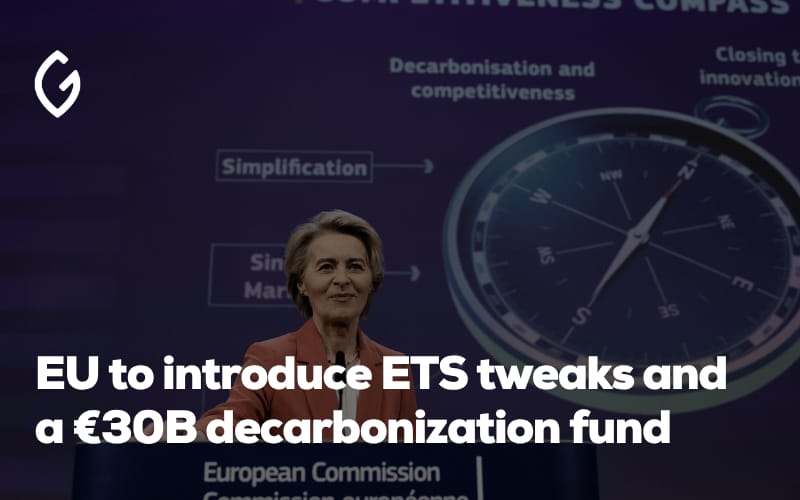
🇪🇺 European Commission President Ursula von der Leyen said the Commission will propose near-term ETS tweaks within days and launch a €30 billion “ETS investment booster” to support industrial decarbonization. Proposed changes include updating free allocation benchmarks, granting more flexibility for manufacturers, and strengthening the Market Stability Reserve to ease carbon cost pressures and reduce price volatility.
The €30 billion fund, financed through ETS allowances, will support clean technology deployment across the EU, with a focus on rapid, accessible financing, alongside targeted national measures to address high energy prices and support industry amid rising economic pressure. A broader ETS review is planned by July 2026.
EU countries warn ETS risks industrial competitiveness, while some companies defend it and urge focus on energy costs and electrification
Ten EU countries urged the Commission to review the ETS, warning it poses an “existential risk” to industry amid high energy prices and inflation. They called for extending free allowances beyond 2034, slowing their phase-out, reducing carbon price volatility, and lowering electricity costs to protect competitiveness. The push reflects growing divisions within the EU, with some countries defending the ETS while others demand urgent reforms.
Meanwhile, over 100 companies, including IKEA, Unilever, and Volvo, warned that blaming Europe’s carbon market for industrial challenges is a “serious misdiagnosis,” urging targeted reforms rather than weakening the EU ETS. They argued that high energy costs and structural issues, not carbon pricing, are the real problems, and called for stronger investment in electrification, grids, and clean technologies. A separate statement emphasized that a robust carbon price is essential for decarbonisation and long-term competitiveness, urging policymakers to focus on implementation and accelerating electrification rather than rolling back climate policies.
In related EU news, the Platform on Sustainable Finance (PSF), an advisory body to the EU Commission, published its response on the revised European Sustainability Reporting Standards (ESRS), broadly supporting the simplifications but warning that some changes risk weakening alignment with global standards. Key proposals include better integration with the EU taxonomy to reduce duplication, stronger inclusion of taxonomy metrics in transition plans, and improved consistency across ESRS, SFDR, and benchmark regulations. The Platform highlighted that voluntary standards should remain aligned with ESRS without discouraging adoption, and should allow large companies to continue reporting voluntarily where needed for investor requirements.
It also called for the development of a centralized, machine-readable reporting platform integrated with the European Single Access Point, noting that with thousands of companies removed from CSRD scope, voluntary reporting will need to be structured and credible. The recommendations come as the European Commission prepares to revise ESRS under the CSRD Omnibus changes, with a Delegated Act expected before summer 2026 based on input from EFRAG and other EU bodies.
MORE INTERESTING NEWS
Latest developments, reports, insights, and trends

🇺🇸 Latest developments across the US
US states sue to block repeal of key emissions regulation framework
A coalition of 23 US states and 17 cities filed a federal lawsuit challenging the repeal of the 2009 Endangerment Finding that underpins US greenhouse gas regulation. Led by several state Attorneys General, the suit argues the repeal ignores scientific evidence and violates the Clean Air Act and a 2007 Supreme Court ruling recognizing GHGs as pollutants. The move could eliminate emissions standards across sectors, and the lawsuit seeks to reinstate the finding and restore the government’s authority to regulate emissions.
New York proposes delaying 2030 climate target amid cost concerns
New York Governor Kathy Hochul proposed revising the state’s climate law, arguing the 2030 target of a 40% emissions reduction is too costly and unattainable. The proposal would delay regulatory requirements until 2030 and introduce a new 2040 emissions target, while maintaining the existing 2050 goal. Hochul cited factors including post-COVID inflation, supply chain disruptions, and reduced federal support for clean energy as key reasons for the changes, stating that meeting the current 2030 target would impose significant costs on businesses and residents.
US settles with TotalEnergies - the company will redirect $928M into fossil fuels
The US and TotalEnergies agreed to cancel offshore wind leases off New York and the Carolinas, with the government reimbursing nearly $1 billion and the company redirecting investment into oil, gas, and LNG projects. The deal aligns with the Trump administration’s push to halt offshore wind development and boost domestic fossil fuel production, with Total committing $928 million to projects including the Rio Grande LNG plant and US upstream operations, drawing criticism from industry groups over the removal of planned wind capacity.
🇬🇧 The UK launched its Fusion Strategy, committing £2.5 billion over five years to develop a domestic fusion industry and a prototype fusion power plant by 2040. The plan includes £1.3 billion for the STEP program, with construction starting in 2030, alongside funding for R&D infrastructure, fusion fuel technology, and a dedicated AI supercomputer.
WHAT ARE COMPANIES DOING?
Corporate sustainability, new tools and services & companies in the news

🔋 China’s leading battery makers gained over $70 billion in market value as the Iran conflict accelerated investor bets on clean energy and energy security, with shares of CATL, BYD, and Sungrow outperforming major oil companies despite rising oil prices. The surge reflects growing concerns over fossil fuel dependency and geopolitical risks, with countries like China and other Asian economies expected to increase investment in renewables and battery storage.
In the US, EV battery makers are pivoting toward energy storage for data centers and utilities as demand changes and policy support for EVs declines. Energy storage is expected to account for 41% of US battery demand this year, up from 26% two years ago, driven by grid needs and incentives that still favor storage over EVs, with companies like LG Energy Solution expanding domestic production amid tariffs on Chinese batteries and rising electricity demand.
In this context, Tesla agreed to buy $4.3 billion worth of battery cells from LG Energy Solution to support its fast-growing energy storage business, with production set at a former LG-GM plant in Michigan. As Tesla expands beyond EVs into systems like Megapacks, the deal underscores its focus on energy growth, which rose 27% last year, despite increasing competition and expected margin pressure.
⚡ Reliance Industries signed a $3 billion, 15-year green ammonia supply agreement with Samsung C&T, one of the largest deals of its kind globally. The partnership, starting around 2029, supports the scale-up of Reliance’s clean energy platform and aligns with India’s ambition to become a global hub for green hydrogen and related fuels, advancing the development of a full green energy value chain.
🌱 Google signed a multi-year agreement with AMP Robotics to purchase 200,000 tonnes of carbon removal credits from a biochar project converting organic landfill waste. The project uses AI-powered waste sorting to divert organic materials and produce biochar, reducing methane emissions and sequestering carbon, with plans to process up to 540,000 tons of waste annually and convert 5 million tons of organic waste over 20 years.
Solutions
🌡️ ERM, Secaro, and AstraZeneca launched the Clean Heat Program to reduce emissions from industrial heat across supply chains. The program combines Secaro’s supply chain data and analytics with ERM’s technical expertise to support solution identification, business case development, and deployment.
📊 ESG.ai partnered with Rho Impact to integrate asset-level climate data into its platform, enhancing investment-grade climate intelligence for European financial institutions. The collaboration enables auditable, forward-looking insights on emissions reduction potential and supports regulatory requirements under SFDR, CSRD, and CBAM.
EVERYTHING FINANCE
Sustainable finance, funding rounds, acquisitions & private equity deals

📈 Norges Bank Investment Management released its Nature Expectations, outlining how portfolio companies should assess, disclose, and manage risks related to land, freshwater, and ocean degradation. The guidance consolidates prior frameworks and will inform engagement, voting, and potential divestment decisions. With 48% of companies already viewing nature risks as financially material, NBIM sets expectations on governance, strategy, disclosure, and target-setting, emphasizing alignment with standards like TNFD and ISSB.
🇪🇺 EU member states are considering removing fossil fuel exclusion requirements from the SFDR, signaling a potential shift in how sustainable investments are defined. Discussions focus on replacing strict exclusions with engagement-based strategies, credibility safeguards, and a clearer ESG classification system, including a baseline “ESG basics” category. While relaxing exclusions could risk channeling capital toward high-emission industries, proponents argue engagement may drive real-world emissions reductions, with the Commission expected to refine the rules shaping trillions in sustainable investments.
🏦 ING mobilized €166 billion in sustainable finance in 2025, up 28% year-on-year, surpassing its €150 billion annual target set for 2027. Growth was driven by strong demand for green loans, which rose 45% and became the leading product category, with Q4 reaching €56 billion. EMEA led activity, while APAC hit record levels.
📈 Standard Chartered closed a $435 million sustainability-linked loan with COFCO International, tied to climate adaptation and social supply chain goals. The facility links financing terms to KPIs, including certified sustainable sourcing and stronger labour safeguards in key agricultural supply chains, marking one of the first loans to integrate adaptation and social resilience outcomes.
Startup funding rounds
⚡️ Fervo Energy secured $421 million to fund the first phase of its large-scale geothermal project in Utah. The Cape Station project, using enhanced geothermal systems, is set to deliver power by 2026, reaching 100 MW by 2027 and scaling to 500 MW, with output already contracted.
🟢 Cocoon Carbon raised $15 million in a Series A round to accelerate deployment of its low-cost, low-carbon cement alternative. The startup converts steel slag from electric arc furnaces into a supplementary cementitious material that matches performance while reducing concrete emissions by up to 40%.
📊 Earth Blox secured £6 million to expand its platform that helps companies and banks assess climate and nature-related risks. The platform integrates satellite, environmental, and financial data to support decision-making on assets, supply chains, and investments, amid rising demand as nature loss increasingly impacts economic performance.
📊 Zevero raised $7 million, bringing total funding to $14 million, to scale its AI-powered carbon management platform and expand internationally. The company, which automates Scope 1–3 emissions tracking and integrates expert guidance, has grown rapidly with 400% ARR growth and a doubled customer base, and recently acquired Inhabit.
🧪 Level Nine raised €4 million in seed funding to scale its catalyst technology that produces industrial chemicals from bio-based materials instead of fossil fuels. The startup uses nanozyme-based catalysts and an AI-driven discovery platform to convert biomass and waste into chemical building blocks with lower energy use and compatibility with existing infrastructure.
🌾 BNP Paribas Asset Management invested in FarmCarbon, a vehicle by Sistema.bio, to scale methane reduction in smallholder farming through carbon finance. The model provides farmers with discounted biodigesters in exchange for carbon credits, enabling renewable energy production and reduced reliance on fossil fuels and fertilizers.
Did you like today's newsletter? |
PARTNER WITH US

Increase your brand awareness and visibility by reaching the right audience and target market. Showcase your company, solutions, services, products, reports, surveys, events, or other content in front of our highly targeted audience of +6,500 Sustainability & ESG professionals. Contact us at [email protected] if you think we can partner in some way.