- Green Digest
- Posts
- What's Happening in Sustainability & ESG (07.04 - 13.04) 🌎
What's Happening in Sustainability & ESG (07.04 - 13.04) 🌎
EU considers aligning sustainability reporting with ISSB standards

Green Digest
April 14, 2026

This week’s read time: 8 minutes
Welcome to this edition of Green Digest, where you will get updated about everything happening in the Sustainability & ESG space in less than 10 minutes. 🌎
We go through tons of articles and data from the most reliable sources, filter & simplify them, and serve them to you in bite-sized chunks every week. 🍀
In this edition, we’ll cover:
• EU considers aligning sustainability reporting with ISSB standards 🇪🇺
• The number of companies with SBTi-approved net-zero targets rose 61% in 2025 to 2,325 📑
• GHG Protocol outlined proposed updates to its Scope 3 Standard 📑
• Microsoft is reportedly pausing new carbon removal purchases ⏸️
• 63% of organizations still rely on spreadsheets or manual systems for sustainability data - Reuters report 📊
• and other news 🌍
PRESENTED BY UPRIGHT PROJECT
WEBINAR: How to quantify climate risk in financial terms
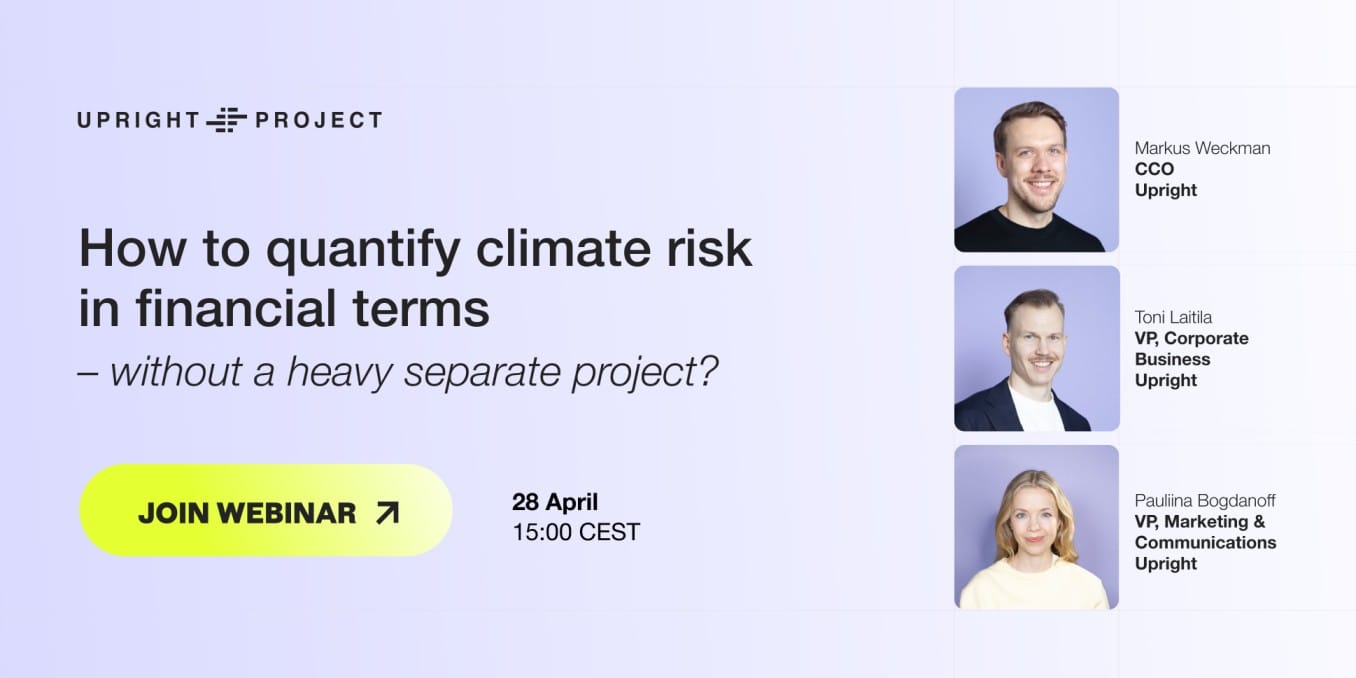
🗓️ Tue, April 28 | 15:00 CEST
Join Upright's webinar to assess climate risk across scenarios from specific sites to your entire value chain, all translated into financial effects.
You'll learn:
Why financial climate risk quantification is now essential
Why integrate climate risk assessment directly into a DMA
Live demo
Trusted by 300+ companies incl. Orkla, Pictet, and Nasdaq.
THIS WEEK’S TOP NEWS
Regulatory Oversight & Industry Insights

🇪🇺 The European Commission is considering a last-minute move to align the EU’s sustainability reporting framework (ESRS) more closely with the International Sustainability Standards Board (ISSB), potentially allowing companies to comply with both without additional reporting. The proposal focuses on separating financially material information from broader impact-related disclosures, ensuring that investor-relevant data is clearly presented and not “obscured” by other sustainability information. A near-final draft is expected shortly, followed by a four-week public consultation period.
The proposed changes come after significant revisions to ESRS by EFRAG, which removed 71% of data points and introduced relief measures. If adopted, the new approach could provide a practical pathway for CSRD-covered companies to align with ISSB standards, as long as financial materiality remains clearly prioritized. ISSB Chair Emmanuel Faber indicated that discussions with EU institutions suggest a potential route for ESRS to achieve full ISSB adopter status under these conditions.
However, stakeholders have raised concerns that stricter separation between financial and impact materiality could undermine the EU’s double materiality principle, increase compliance complexity, and raise costs. Critics argue that introducing a hierarchy between financial and impact disclosures risks weakening the broader purpose of sustainability reporting and could require companies to redo materiality assessments and sustainability statements.
French industry groups and other stakeholders have warned that such changes contradict the foundations of the EU framework, where financial and impact materiality are meant to be complementary. While some support improved interoperability between ESRS and ISSB to reduce reporting burdens, there are concerns about fragmentation and implementation challenges. The final impact will depend on how the Commission defines presentation requirements, with the broader debate highlighting tensions between global standardization and the EU’s distinct sustainability reporting approach.
MORE INTERESTING NEWS
Latest developments, reports, insights, and trends

Credit: SBTi
📑 The number of companies with SBTi-approved net-zero targets rose 61% in 2025 to 2,325, driven by strong growth in healthcare and Asian markets. Asia led the expansion, with a 92% increase in Chinese firms and continued momentum across Japan, India, and emerging markets, signaling a shift in climate leadership beyond Europe. While near-term target validation also grew by 40%, the surge in long-term commitments is reshaping investor frameworks, with providers like MSCI reconsidering how climate indices are constructed as more companies adopt science-based targets.
📑 GHG Protocol outlined proposed updates to its Scope 3 Standard, including a new requirement for companies to report at least 95% of value chain emissions and the introduction of a new optional “Category 16” for additional activities like facilitated emissions. The revisions aim to improve data quality, transparency, and consistency, while refining rules around categories such as investments, as part of a broader effort to strengthen global corporate emissions reporting standards.
GHG Protocol and ISO have also formed a new working group of 22 experts from companies like Unilever, Amazon, Volkswagen, and BMW to develop joint product-level carbon accounting standards. The initiative reflects growing demand for more consistent and comparable emissions measurement at the product level, building on existing frameworks from both organizations.
WHAT ARE COMPANIES DOING?
Corporate sustainability, new tools and services & companies in the news

⏸️ Microsoft is reportedly pausing new carbon removal purchases, a move that could reshape a market it has largely driven. According to Bloomberg and Heatmap, the company has signaled a halt to new deals with suppliers, although it has not officially confirmed the pause, stating it is continuously reviewing its portfolio in line with its carbon-negative goals. Microsoft has been the dominant buyer in the space, accounting for around 96% of global carbon removal purchases in 2025, with record agreements totaling 45 million tonnes of CO₂ and partnerships across 21 providers. While new purchases may slow, existing long-term contracts are expected to continue channeling billions into the market. Shortly before the reports, Microsoft signed a long-term deal with Svante and the Meadow Lake Tribal Council to supply over 626,000 tonnes of carbon removal credits from a BECCS project in Canada.
🟢 In related news, JPMorganChase signed a deal with Graphyte to supply 60,000 tons of carbon removal credits over ten years from its US-based biomass sequestration projects. The agreement supports Graphyte’s low-cost “Carbon Casting” technology and reflects growing corporate demand for scalable, durable carbon removal solutions. The bank also signed a deal with Anew Climate and Aurora Sustainable Lands to supply over 85,000 tons of carbon removal credits from US forest management projects. The agreement uses advanced monitoring and dynamic baselining methods, reflecting growing demand for high-integrity, nature-based carbon removal solutions.
⚡️ Rolls-Royce SMR signed a contract with Great British Energy – Nuclear (GBEN) to deliver the UK’s first small modular reactors at Wylfa, North Wales. The agreement enables immediate work on three units, supported by £2.5 billion in government funding and an additional £599 million commitment from the National Wealth Fund. The project marks a major step in the UK’s clean energy strategy, with SMRs offering faster deployment, grid flexibility, and carbon-free power as part of a broader push to scale next-generation nuclear energy.
Solutions
📊 63% of organizations still rely on spreadsheets or manual systems for sustainability data, up from 57% last year, highlighting a widening infrastructure gap. According to a new Reuters Events report, data quality remains the top challenge (48%), while 58% plan to increase investment over the next three years, though most expect only 11%–20% growth, insufficient to close the gap. Standardization (41%) and rising data volumes (39%) further complicate reporting, especially as Scope 3 expands, while regulatory uncertainty has become the top barrier to tech investment (47%, up from 30%), overtaking cost.
📊 Apave launched Apave Impact, a new sustainability-focused unit, supported by its acquisition of Dutch consulting firm De Duurzame Adviseurs. The platform brings together over 100 experts to offer services including emissions measurement, decarbonization strategies, and CSRD compliance, strengthening Apave’s global sustainability advisory capabilities.
EVERYTHING FINANCE
Sustainable finance, funding rounds, acquisitions & private equity deals

🇨🇦 Canada appointed a new Taxonomy and Transition Planning Council to oversee the development of its sustainable finance taxonomy and climate transition guidance. The council will define criteria for green and transition investments and support companies in planning and disclosing climate strategies, as part of the government’s plan to launch a national taxonomy by 2026.
⚡️ Amundi made a strategic investment in Youdera to support its €150 million expansion in distributed solar and energy infrastructure for commercial and industrial clients across Europe. The funding will help scale Youdera’s model of delivering solar and storage solutions without upfront costs, enabling businesses to reduce energy expenses and advance decarbonization.
M&A
📊 Makersite acquired SiGREEN from Siemens, a leading platform for product carbon footprint data exchange across global supply chains. The deal strengthens Makersite’s capabilities in supplier data and enables seamless sharing of verified emissions data across major frameworks, helping manufacturers better measure and reduce product-level environmental impact.
📊 SLR acquired climate analytics platforms Planetrics and ClimSystems to strengthen its digital services offering and enhance climate risk modelling capabilities. The move responds to growing demand for asset-level insights on physical and transition risks, enabling clients to better assess value-at-risk, anticipate regulatory changes, and make more informed investment and resilience decisions.
⚡️ Energy Vault acquired an 850 MW portfolio of battery storage projects in Japan, marking its entry into the market. The deal includes both advanced and early-stage projects and positions the company to capitalize on rapid growth in Japan’s energy storage sector, driven by grid constraints and rising renewable penetration.
Funds
📈 Australian Ethical Investment launched a new Growth Opportunities Fund, backed by A$500 million and up to A$125 million from the Clean Energy Finance Corporation, targeting private market investments with financial returns and measurable impact. The fund will focus on areas like decarbonization, recycling, and renewable infrastructure, aiming for 11%–13% annual returns.
📈 Triodos Investment Management and Fondaction launched Value Nature Fund I, a natural capital fund targeting up to €300 million to invest in regenerative agriculture and sustainable forestry across North America and Europe. The fund aims to transition farmland and forests to nature-positive practices while delivering climate, biodiversity, and social impact alongside long-term financial returns.
📈 Eka Ventures raised £80 million ($107 million) for its second fund to invest in early-stage UK startups focused on sustainability, health, and inclusive growth. The fund will back around 30 companies, targeting solutions across consumer systems such as healthcare, resource efficiency, and decarbonization.
Startup funding rounds
🟢 Ara Partners will invest up to $500 million in Sedron Technologies to scale its waste-to-resource solutions that convert biosolids and agricultural waste into clean water, energy, and carbon-negative products. The funding will accelerate project development and deployment of its Varcor technology across North America.
🛩️ Sora Fuel raised $14.6 million to scale its technology for producing sustainable aviation fuel using only water, air, and renewable energy. The startup’s approach captures CO₂ directly from the air and converts it into fuel more efficiently than traditional methods, targeting carbon capture costs below $50 per ton and fuel production under $5 per gallon.
Did you like today's newsletter? |
PARTNER WITH US

Increase your brand awareness and visibility by reaching the right audience and target market. Showcase your company, solutions, services, products, reports, surveys, events, or other content in front of our highly targeted audience of +6,500 Sustainability & ESG professionals. Contact us at [email protected] if you think we can partner in some way.