- Green Digest
- Posts
- What's Happening in Sustainability & ESG (03.03 - 09.03) 🌎
What's Happening in Sustainability & ESG (03.03 - 09.03) 🌎
The EU unveiled the new Industrial Accelerator Act, widely viewed as climate policy in disguise

Green Digest
March 10, 2026

This week’s read time: 8 minutes
Welcome to this edition of Green Digest, where you will get updated about everything happening in the Sustainability & ESG space in less than 10 minutes. 🌎
We go through tons of articles and data from the most reliable sources, filter & simplify them, and serve them to you in bite-sized chunks every week. 🍀
PRESENTED BY SE ADVISORY SERVICES
AI for Sustainability: A Webinar on What Actually Delivers ROI

AI promises efficiency in sustainability – but where does it truly deliver value? Join our webinar March 24 to explore how finance-grade data, governance, and expert insight turn AI into measurable ROI and confident decarbonization decisions.
In this edition, we’ll cover:
• The EU unveiled the new Industrial Accelerator Act, widely viewed as climate policy in disguise 🇪🇺
• Investors support GHG Protocol’s Scope 2 changes, while EFRAG urges a balanced approach 📑
• A survey of 688 German companies found that only 17% currently see a clear business case for sustainability 📑
• Several companies used carbon credits from a project in Brazil even after it was suspended in 2023 over concerns about land rights and emissions claims 🌳
• Major companies, including Amazon and Google, launched the Superpollutant Action Initiative to mobilize $100 million by 2030 to tackle highly potent climate pollutants 🟢
• and other news 🌍
PRESENTED BY KANATAQ
New Report: The Sustainability Solutions Acquisition Wave
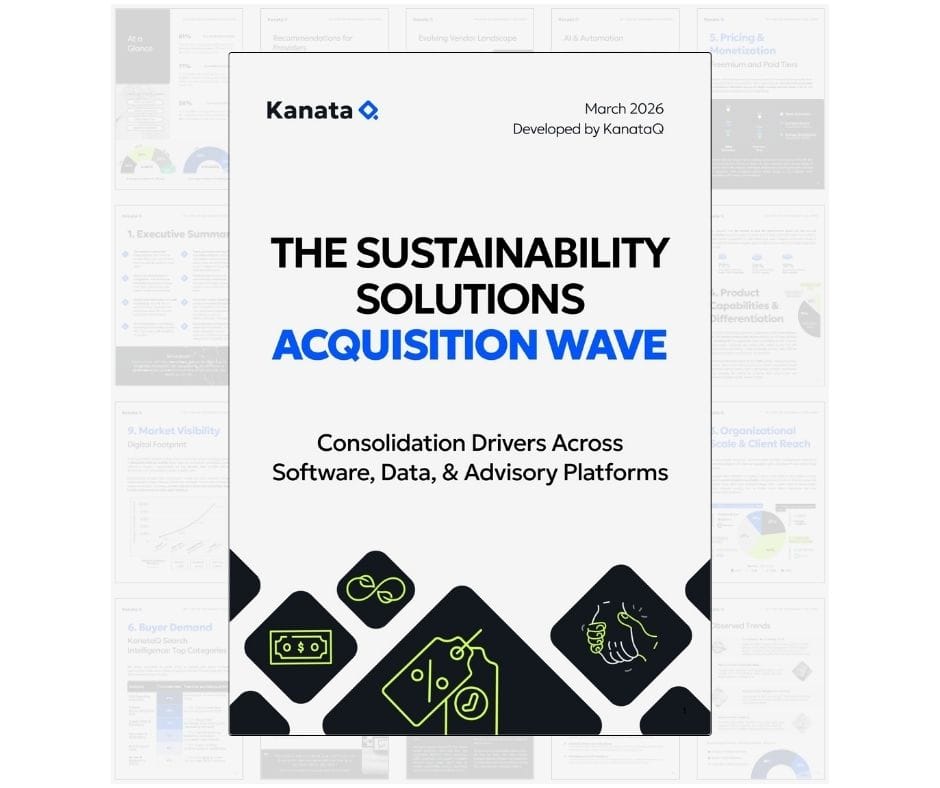
The Sustainability Solutions Acquisition Wave report by KanataQ analyzes 25 disclosed acquisitions between February 2025 and February 2026 across ESG reporting, carbon management, supply chain due diligence, LCA, data platforms, and advisory services. This report reveals how the sustainability solutions market has entered its first consolidation cycle - shifting from rapid expansion to strategic integration driven by audit-readiness, domain credibility, and enterprise buyer scrutiny.
✔ 25 Acquisitions Mapped
✔ Deal Archetypes Identified
✔ Strategic Market Intelligence
THIS WEEK’S TOP NEWS
Regulatory Oversight & Industry Insights
🇪🇺 The European Commission unveiled the long-awaited Industrial Accelerator Act (IAA), a central pillar of its industrial and decarbonization agenda aimed at strengthening EU manufacturing while accelerating the clean transition. At its core, the proposal is designed to create more demand for low-carbon products and clean technologies made in Europe, while helping domestic industries compete against foreign producers facing lower energy costs, lighter regulation, or stronger state support. The proposal will now be debated in the European Parliament and Council before being adopted later in the year.
The proposal uses public procurement and public support schemes to build “lead markets” for strategic sectors such as batteries, solar, wind, heat pumps, nuclear, electric vehicles, steel, aluminium, and cement. In practice, this means introducing “Made in EU” and/or low-carbon requirements so that when public money is spent, a minimum share of certain products must be manufactured in Europe or meet emissions-related criteria. By doing so, the EU is trying to use its large public purchasing power to give cleaner industrial products a more predictable demand and encourage investment in domestic production capacity.
The IAA is being widely interpreted as a climate policy framed through an industrial and geopolitical lens. Rather than presenting decarbonization as a standalone sustainability objective, the proposal ties it to sovereignty, resilience, supply chain security, and strategic autonomy. In that sense, the Act can be seen as a climate law in disguise: one that channels taxpayer money toward greener materials and technologies, not through new climate burdens, but by embedding sustainability into industrial policy, competitiveness, and the EU’s effort to reduce critical dependencies.
EU member states also approved amendments to the EU Climate Law, setting a new target to cut GHG emissions by 90% by 2040, marking the final step before formal adoption. The revised law allows limited use of international carbon credits for up to 5% of reductions and includes periodic reviews of the target. It also delays the expansion of the EU carbon market (ETS2) to 2028 while adding flexibility for member states to meet sectoral climate goals.
MORE INTERESTING NEWS
Latest developments, reports, insights, and trends

Source: Sustainability Transformation Monitor (STM) | Credit: Andreas Rasche
📊 A survey of 688 German companies found only 17% currently see a clear business case for sustainability, highlighting ongoing challenges in translating sustainability efforts into financial value. Key barriers include short-term investment horizons, difficulties quantifying benefits, underpriced environmental externalities, and organizational silos separating sustainability costs and gains. The findings suggest that stronger regulatory predictability could reduce uncertainty and help companies justify long-term sustainability investments.
📑 As the Greenhouse Gas (GHG) Protocol is undertaking a major update to its Scope 2 emissions, a group of 14 investors managing over $1.2 trillion in assets urged the organization to move forward with the proposed changes to better reflect the real carbon impact of companies’ electricity use. They argue that current standards allow firms to report zero emissions while still relying on fossil-based electricity, creating misleading disclosures. Proposed reforms include hourly matching of renewable energy use, location-based electricity claims, and phased implementation to improve transparency and support the clean energy transition.
Meanwhile, in late February, EFRAG called for a balanced and cost-effective approach to proposed updates to the GHG Protocol’s Scope 2 emissions guidance. While supporting improved accuracy and comparability in emissions reporting, EFRAG warned that some proposals could be overly complex and costly for companies. The organization urged clearer consultation materials, longer feedback periods, pilot testing before rollout, and a principles-based framework that allows jurisdictions to adapt technical details to local markets and regulations.
🇨🇳 China announced new climate targets in its latest five-year plan, aiming to cut CO₂ emissions intensity by 3.8% in 2026 and 17% by 2030 while maintaining GDP growth of 4.5–5%. The plan reiterates goals to peak emissions by 2030 and reach carbon neutrality by 2060, while increasing non-fossil energy to about 25% of the energy mix by 2030.
🇸🇬 Singapore’s Monetary Authority released new guidelines requiring banks, insurers, and asset managers to strengthen climate transition planning and environmental risk management. The rules expect financial institutions to integrate climate risks into governance, strategy, and risk frameworks while improving climate data capabilities.
🇰🇷 South Korea’s Financial Services Commission released a draft roadmap to introduce mandatory sustainability disclosures starting in 2028 for large KOSPI-listed companies, based on 2027 data. The framework aligns with ISSB standards and will initially apply to firms with assets above KRW 30 trillion, potentially expanding to smaller companies over time.
WHAT ARE COMPANIES DOING?
Corporate sustainability, new tools and services & companies in the news

🌳 Several companies, including Mastercard, BlackRock, and Philip Morris, used carbon credits from the Pacajai REDD+ project in the Brazilian Amazon even after it was suspended in 2023 over concerns about land rights and the validity of its emissions reductions. The project was halted by the carbon registry Verra while it investigates whether developers had legal authorization to operate on public land, yet credits issued earlier continued to be traded and retired by companies as offsets.
The case highlights broader credibility challenges in voluntary carbon markets, where companies can still use credits from projects facing environmental or legal scrutiny. Millions of Pacajai credits were retired despite warnings from ratings agencies about their low likelihood of delivering real climate benefits, underscoring ongoing concerns about transparency, verification, and the reliability of carbon offset projects.
🌍 A group of major companies, including Amazon, Autodesk, Figma, Google, JPMorganChase, Salesforce, and Workday, launched the Superpollutant Action Initiative to mobilize $100 million by 2030 for projects that capture or destroy highly potent climate pollutants. These pollutants are responsible for roughly half of global warming and are linked to sources such as agriculture, fossil fuel production, landfills, and cooling systems. Managed by the Beyond Alliance, the initiative will fund high-integrity mitigation projects and develop best practices, while companies like Google and Workday already support methane-reduction credit projects.
⚡ Energy company Moeve approved an investment decision to build Southern Europe’s largest green hydrogen project in Spain, with a first-phase capacity of 300 MW. The Onuba facility is expected to produce about 45,000 tons of green hydrogen annually and cut roughly 250,000 tons of CO₂ emissions, supporting decarbonization in aviation, shipping, road transport, and heavy industry.
⚛️ TerraPower received the first-ever US construction permit for a commercial-scale advanced nuclear reactor using its Natrium technology. The 345 MW reactor, located in Kemmerer, Wyoming, will include molten salt energy storage capable of boosting output to 500 MW during peak demand.
🌳 Carbonfuture signed a multi-year agreement with Boeing for at least 40,000 tons of durable carbon removal credits sourced from biochar projects in the Global South. Boeing will use the credits to address residual Scope 3 emissions from business travel as part of its “avoid first, remove second” carbon strategy.
🧪 L’Oréal signed a multi-year offtake agreement with cleantech startup Dioxycle to convert captured carbon emissions into sustainable ethylene used for polyethylene packaging materials. Dioxycle’s technology uses a low-temperature electrolyzer powered by recycled CO₂, water, and renewable electricity to produce ethylene, traditionally made from fossil fuels.
Solutions
📊 London Stock Exchange Group launched LSEG Sustainability Ratings and Data, a new ESG analytics platform designed to help investors evaluate companies’ management of sustainability risks and opportunities. The dataset covers more than 16,000 companies and 1 million fixed-income instruments using 220 indicators and a rules-based methodology aligned with frameworks such as ISSB, GRI, SASB, and ESRS.
EVERYTHING FINANCE
Sustainable finance, funding rounds, acquisitions & private equity deals

⚡ Norges Bank Investment Management, BCI, and Brookfield launched Northview Energy, a new platform to acquire and operate renewable energy assets in the US and Canada. The platform will start with a $2.6 billion portfolio of 22 operating solar and wind assets totaling about 2.3 GW, backed by long-term power purchase agreements. The partners also plan future acquisitions of de-risked renewable assets, supported by up to $1.5 billion in additional equity.
🔋 TotalEnergies agreed to sell a 50% stake in 11 battery storage projects in Germany to Allianz Global Investors, with the portfolio representing about €500 million in investment. The projects, developed by Kyon Energy and expected to reach 789 MW of capacity by 2028, aim to strengthen Germany’s grid flexibility and support renewable energy expansion.
⚡️ Global investment manager Schroders’ renewable infrastructure investment unit, Schroders Greencoat, launched a green digital infrastructure platform to invest in renewable-powered data centres and energy parks supporting the rapid growth of AI. The platform, a joint venture with Greencoat Renewables, will focus initially on Ireland, combining grid access, land, and renewable energy to serve hyperscalers.
Funds
🏢 Climate investment firm Galvanize raised $370 million for its first real estate fund focused on increasing property value through decarbonization strategies. The fund targets undercapitalized commercial buildings in high-growth US markets and aims to boost net operating income through measures such as solar deployment, electrification, and energy efficiency upgrades.
M&A
⚡ A consortium led by Global Infrastructure Partners and EQT agreed to acquire US energy company AES in a $33.4 billion deal to support growing demand for reliable and low-carbon power. The transaction reflects rising investment in electricity infrastructure driven by data center and AI-related energy demand. AES plans to accelerate renewables and power generation growth, with the deal providing the capital needed to fund new capacity and grid investments.
🧪 Carbon capture technology company Svante acquired carbon removal project developer Carbon Alpha to expand its capabilities as an integrated carbon management provider. The deal adds Carbon Alpha’s BECCS expertise and the North Star carbon removal project in Canada, expected to capture up to 140,000 tons of CO₂ annually. The acquisition strengthens Svante’s ability to scale durable carbon removal solutions and supply high-integrity carbon credits.
📊 XeleratedFifty acquired enterprise carbon management software company Terrascope to expand tools helping businesses measure and reduce emissions. Terrascope’s AI-powered platform tracks Scope 1, 2, and 3 emissions, particularly for agriculture, commodities, and food sectors. The acquisition aims to accelerate the development of analytics and regulatory compliance features, including support for frameworks such as CBAM and emerging carbon accounting standards.
Startup funding rounds
🟢 Cleantech startup RIFT raised €113.8 million through a Series B round and EU funding to scale its iron fuel technology for decarbonizing industrial heat. The system burns iron powder to generate heat without direct CO₂ emissions, acting like a rechargeable battery for industrial processes.
🧴 Biomaterials startup Shellworks raised $15 million in Series A funding to scale production of its plant-based Vivomer material. The material, produced through microbial fermentation of waste feedstocks such as used cooking oil, is designed to replace plastics while remaining fully biodegradable.
🔋 Battery technology company EGI Battery raised $10 million in seed funding to expand manufacturing and accelerate development of lithium-ion batteries for aerospace, robotics, and unmanned systems.
Did you like today's newsletter? |
PARTNER WITH US

Increase your brand awareness and visibility by reaching the right audience and target market. Showcase your company, solutions, services, products, reports, surveys, events, or other content in front of our highly targeted audience of +6,500 Sustainability & ESG professionals. Contact us at [email protected] if you think we can partner in some way.