- Green Digest
- Posts
- Interview Series: Donato Calace
Interview Series: Donato Calace
The current state of sustainability regulation and how companies should navigate it

Green Digest
March 13, 2026

This week’s read time: 5 minutes
Welcome to the Green Digest Interview Series, our weekly feature showcasing conversations with the industry’s leading voices - CSOs, sustainability directors, and other senior professionals shaping the sustainability landscape. Each edition dives into their professional journeys, hands-on insights, and outlook on the challenges and opportunities defining corporate sustainability.
These interviews are designed to be quick, insightful reads, offering you actionable takeaways and a personal glimpse into the people leading the way. Stay tuned for stories, strategies, and lessons that matter to you.
PROFILE
This week’s guest:
Donato Calace
SVP, Market Leader, Partnerships & Innovation at Datamaran

Donato Calace is SVP, Market Leader, Partnerships & Innovation at Datamaran, and is widely recognized as the company’s resident expert on ESG regulation and materiality. Based in London, he plays a central role in shaping Datamaran’s product direction by acting as a bridge between customers, partners, and internal product and technology teams.
A well-known thought leader on the evolving ESG landscape, Donato regularly shares insights with corporate sustainability professionals, helping organizations navigate complex regulatory requirements and integrate ESG considerations into strategic decision-making.
Before moving into leadership, Donato began his career as an ESG research specialist and analyst, building deep expertise in non-financial data, risk, and reporting. He holds a PhD in the Economics and Management of Natural Resources, bringing academic rigour to sustainability challenges.
A true Italian, he loves making difficult concepts such as materiality digestible thanks to food analogies. Known for his energy and curiosity, Donato is a passionate sustainability tech evangelist, championing how data-driven innovation enables organizations to turn sustainability into a strategic discipline that builds resilience, strengthens long-term performance, and helps them shape their future.

Sustainability regulation is evolving unevenly across major markets. What characterizes this current phase of global regulatory development, and how does the direction of travel differ between Europe, the US, and Asia?
We are entering a more mature but highly fragmented phase of sustainability regulation. Globally, ESG regulations have grown from a few hundred in 2016 to nearly 30,000 today, with more than 3,600 new rules introduced in 2025. Datamaran’s Regulatory Monitoring solution is powered by a database that currently contains over 19,800 regulations across 190 jurisdictions. This illustrates the scale and speed of change companies are currently navigating.
We're finally turning the page on the theory of change exclusively based on providing material information to capital markets and hoping the invisible hand does the rest. There's a slowdown on policy focused on disclosure and ESG investment integration, and new policies affecting the 'real' economy (trade, manufacturing, goods) are emerging very rapidly. Circularity, energy efficiency & batteries, EPR, CBAM regimes, and water stewardship are hot topics and relatively safe from political witch-hunting.
In Europe, led by the European Union, the focus has shifted from expansion to consolidation. Omnibus I, ESRS simplifications, and SFDR reforms signal a move toward proportionality and implementation quality. Although in the short term, the introduction of these changes has created more confusion and complexity for the companies that fell within the original scope.
In the US, federal rollbacks contrast with strong state-level action, particularly in states like California and Illinois, creating fragmentation. Across Asia, jurisdictions are selectively aligning with ISSB-style standards. Overall, regulation is diverging regionally, requiring companies to manage complexity rather than rely on harmonization.
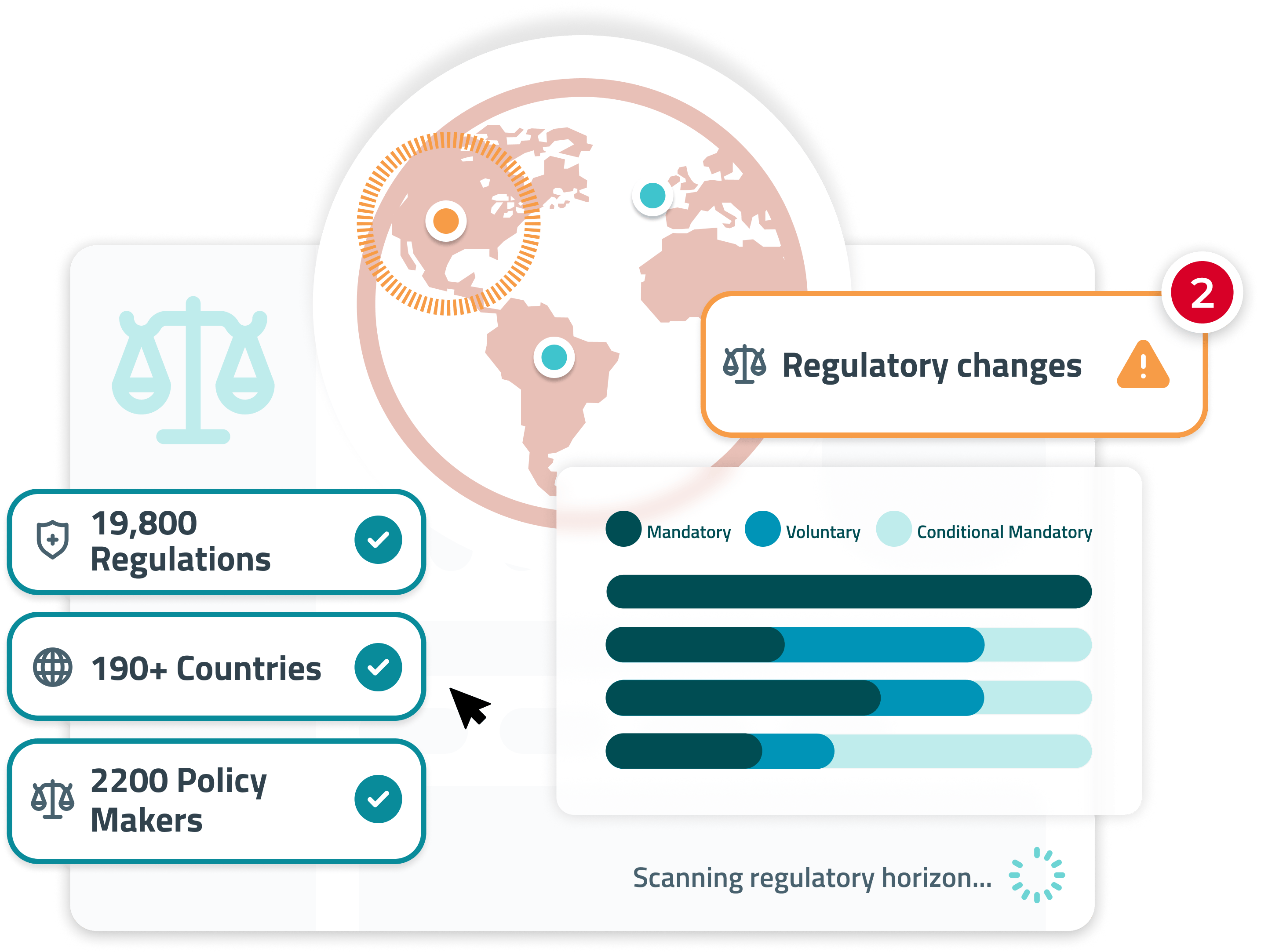
Datamaran’s solution tracks nearly 19,800 sustainability regulations across more than 190 jurisdictions worldwide
What does this rising regulatory complexity mean for corporate strategy and governance at the board level?
Regulatory complexity is reshaping board accountability. ESG is no longer a reporting exercise — it is a governance and capital-allocation issue. Several sectors now face over 2,000 ESG regulations, and infrastructure alone is subject to more than 3,300 globally.
Boards must oversee compliance across climate disclosure and carbon-related regulations, supply-chain due diligence, labor rights, and anti-greenwashing regimes, often with extraterritorial reach. Recent enforcement cases show regulators are increasingly focused on governance failures, internal controls, and misleading claims.
As a result, boards are strengthening regulatory literacy, establishing dedicated oversight structures, and embedding ESG into enterprise risk management. Leading companies are linking executive incentives to ESG performance. In this environment, governance maturity is becoming a competitive advantage, not just a risk-management requirement.
How can companies design more resilient compliance approaches that remain robust even as rules evolve or change direction? What does “good architecture” look like in practice?
Resilient compliance requires moving beyond reactive monitoring toward a structured Monitor > Discover > Manage framework. This is essential in a landscape where ESG regulations are in the tens of thousands globally and continue to grow each year. At Datamaran, this is the framework we advocate, and it also underpins the design of our new Regulatory Monitoring solution.
The Monitor component establishes continuous, real-time tracking across jurisdictions, replacing fragmented spreadsheets and alerts. Discover then applies AI and expert insight to filter thousands of updates into prioritized risks and opportunities aligned to sector and value-chain exposure. This ensures companies focus on what truly matters.
The Manage component is about embedding these insights into governance workflows. Together, Monitor > Discover > Manage creates an architecture that remains effective as rules evolve and grow.
What led you to launch the new Regulatory Monitoring solution? What was broken in the way companies were tracking regulatory change before this?
Historically, ESG regulatory monitoring was manual, fragmented, and reactive. Companies relied on spreadsheets, consultant reports, and generic alerts — tools never designed for managing tens of thousands of overlapping ESG obligations.
With over 3,600 new regulations introduced in 2025, this approach became unsustainable. It led to late responses, duplicated work, and important missed signals.
The Datamaran Regulatory Monitoring solution replaces this with AI-driven horizon scanning, impact scoring, and governance workflows. It enables teams to map regulations to material issues, prioritize by risk, and coordinate action across teams in real time. Monitoring becomes a strategic capability — supporting earlier investment, supply-chain, and disclosure decisions — rather than a last-minute compliance exercise.
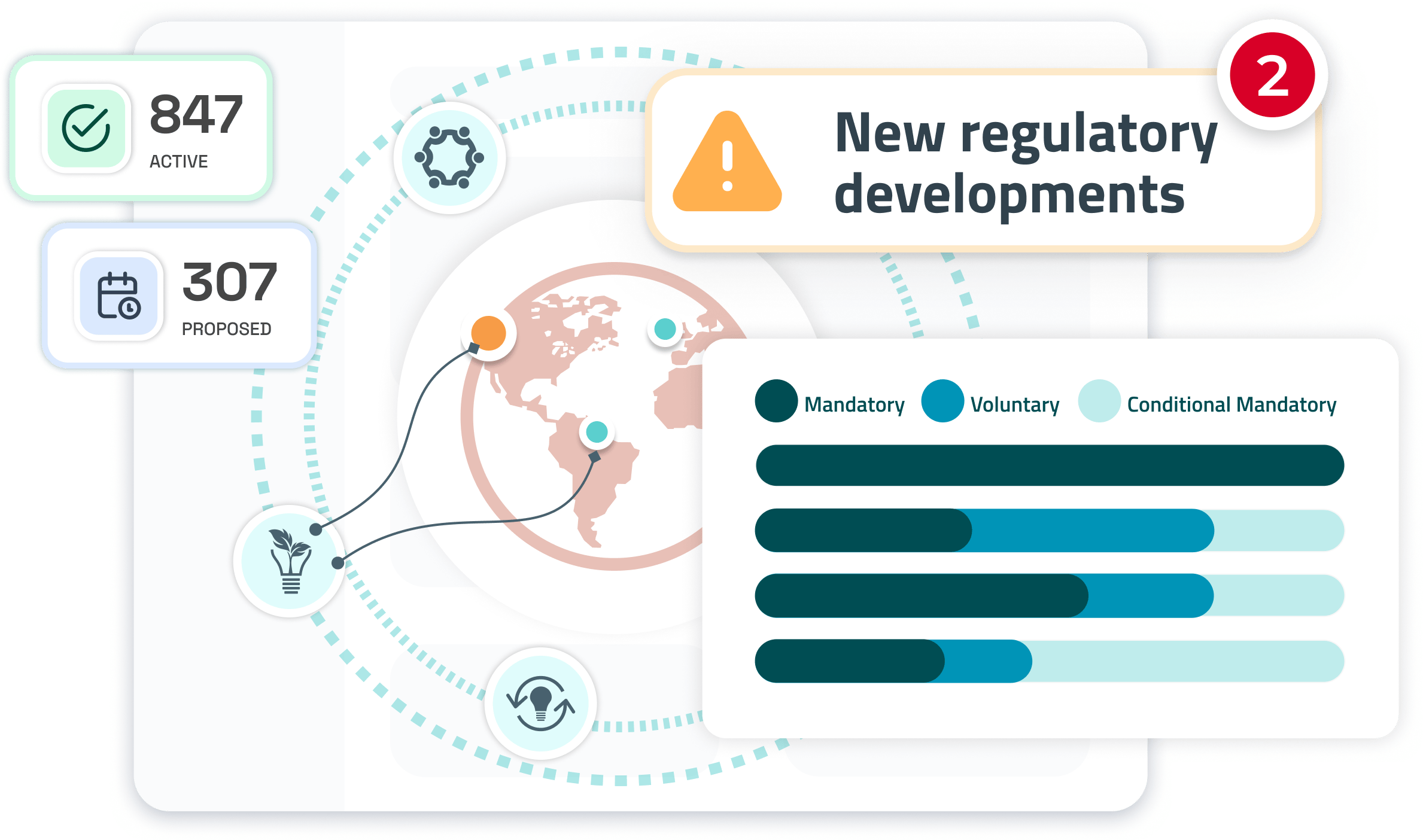
Snapshot of Datamaran’s regulatory monitoring solution
In the next two to five years, do you expect sustainability regulation to stabilize, or continue evolving? What should companies be preparing for?
We do not expect full regulatory stabilization in the next two to five years. Instead, we will see continued evolution, focused on enforcement, data quality, and credibility. Climate-related rules alone have grown from 41 in 2015 to nearly 3,000 in 2025, showing how expectations can, and will, shift over time. We don’t anticipate that changing going forward.
In Europe, refinement and enforcement will intensify. Globally, we expect stronger assurance, tighter anti-greenwashing rules, and greater scrutiny of transition and nature-related claims. Even in markets scaling back politically, investor and market pressure will remain strong.
Companies should therefore prepare for deeper scrutiny, not fewer rules. This means investing in integrated systems, scenario analysis, and assurance-ready processes. Those companies that treat regulation as an early strategic signal will be best positioned for long-term resilience.

Did you enjoy this interview? |
PARTNER WITH US

Increase your brand awareness and visibility by reaching the right audience and target market. Showcase your company, solutions, services, products, reports, surveys, events, or other content in front of our highly targeted audience of +6,500 Sustainability & ESG professionals. Contact us at [email protected] if you think we can partner in some way.