
Why global supply chains are reaching a "big-data breaking point"

This week’s read time: 5 minutes
Welcome to the Green Digest Interview Series, our weekly feature showcasing conversations with the industry’s leading voices - CSOs, sustainability directors, and other senior professionals shaping the sustainability landscape. Each edition dives into their professional journeys, hands-on insights, and outlook on the challenges and opportunities defining corporate sustainability.
These interviews are designed to be quick, insightful reads, offering you actionable takeaways and a personal glimpse into the people leading the way. Stay tuned for stories, strategies, and lessons that matter to you.
Budgets are tightening, reporting demands are diverging, and investor expectations are shifting. Your board wants short-term earnings, stakeholders expect credible progress, and your teams need clarity amid political noise and regulatory fragmentation.
Responsible Business USA 2026 (May 5–6, Boston) is where sustainability leaders regroup, refocus, and build strategies that stick. Join 350 decision-makers for candid conversations, practical workshops, and connections that drive real impact.
Explore what RBUSA has in store for you Reuters Events: Responsible Business USA 2026
This week’s guest:
Catherine Cormier
Chief Innovation Officer at Assent

Catherine Cormier is the Chief Innovation Officer at Assent, where she leads the company’s innovation strategy to expand market opportunities and pioneer AI-driven supply chain intelligence. With over two decades of experience in product management, UX, software development, and leadership, Catherine has consistently driven innovation in technology-focused industries.
She previously held senior roles at high-growth companies, contributing to transformative initiatives in product development and market strategy. With a background in Computer Engineering and a Master of Science (MSc) in electronic business technologies, Catherine brings a systems-oriented and market-shaping approach to product leadership. Her work is focused on redefining how manufacturers understand and act on product-level risk, positioning Assent at the forefront of compliance and sustainability intelligence.
Catherine brings her passion for technology and people to every stage of designing, developing, and delivering Assent’s next-generation platform.

You’ve described global manufacturing ecosystems as having reached a “big-data breaking point.” What has actually broken inside these systems: the tools, the processes, or the expectations themselves?
The “big-data breaking point” isn’t the result of one system failing. It’s the outcome of global manufacturing ecosystems that were never designed around centralized, interoperable data management. Without that foundation, companies are exposed to supply chain risk.
Manufacturers operate in one of the most complex environments in any industry, but many rely on manual processes that can’t handle the required data volumes. The supplier data they have is often incomplete, inconsistent, and unprepared for audit scrutiny.
To make matters worse, they’re under rising pressure from regulators, customers, and investors, with requests increasing faster than most organizations can manage. But this breaking point isn’t a setback — it’s a strategic inflection point. Companies that centralize their supply chain data management and leverage AI innovation in their programs respond faster, have more accurate data, and have a competitive advantage.

Global supply chains are becoming increasingly complex, with data demands rising faster than systems can handle. | Credit: chuttersnap/Unsplash
Suppliers are drowning in ESG and compliance requests. At what point does the pursuit of transparency start introducing the very business risk it is meant to prevent?
The push for greater supply chain transparency introduces business risk when data requirements outpace operational capacity. Suppliers face thousands of compliance requests each week across email and fragmented systems. Collecting and validating accurate data at scale requires significant effort, and those same teams are still responsible for responding to their customers in a reasonable time frame. It isn’t scalable.
This reality has led to the development of tools like request management platforms, which aim to centralize compliance requests into a single dashboard. These systems enable suppliers to respond to customers with greater speed, accuracy, and consistency. By structuring and automating how sustainability and compliance data is collected and processed, they can reduce manual workload and help teams deliver more standardized, audit-ready responses at scale. That’s the context in which our Request Manager was developed.
You’ve said sustainability data must be regulation-agnostic. Why is building sustainability systems around individual laws a structural mistake?
Sustainability systems built around individual regulations limit a company’s ability to scale as requirements evolve. Regulatory change is constant. In 2025 alone, the World Trade Organization recorded 5,206 technical barriers to trade notifications. Point systems force companies into a reactive position, continually adjusting to moving compliance targets without any advanced visibility into risks.
Accurate, complete, and interoperable supply chain data becomes regulation agnostic, and forms the foundation of a sustainability and compliance program that protects their business from loss of revenue, customer contracts, and market access. The same data foundation can support product compliance and sustainability, trade requirements, and responsible sourcing efforts without restarting collection efforts each time.
Assent describes itself as an AI-native platform built to manage supply chain sustainability at scale. In practical terms, how does Assent redesign the way suppliers and manufacturers exchange sustainability data?
The Assent Sustainability Platform delivers AI capabilities that are vastly different from generic artificial intelligence. We layer the technology solutions our customers need with the human-led expertise they trust to deliver a unified product compliance and sustainability, responsible sourcing, and trade compliance solution.
At the heart of our AI-native platform is the Assent Sustainability Network, the world’s largest global network of part, product, and supplier information. It connects manufacturers, suppliers, products, and parts, delivering network intelligence for faster, smarter decision-making. We built it to simplify data-sharing across the manufacturing space, standardize reporting, and facilitate information flow seamlessly through the supply chain.
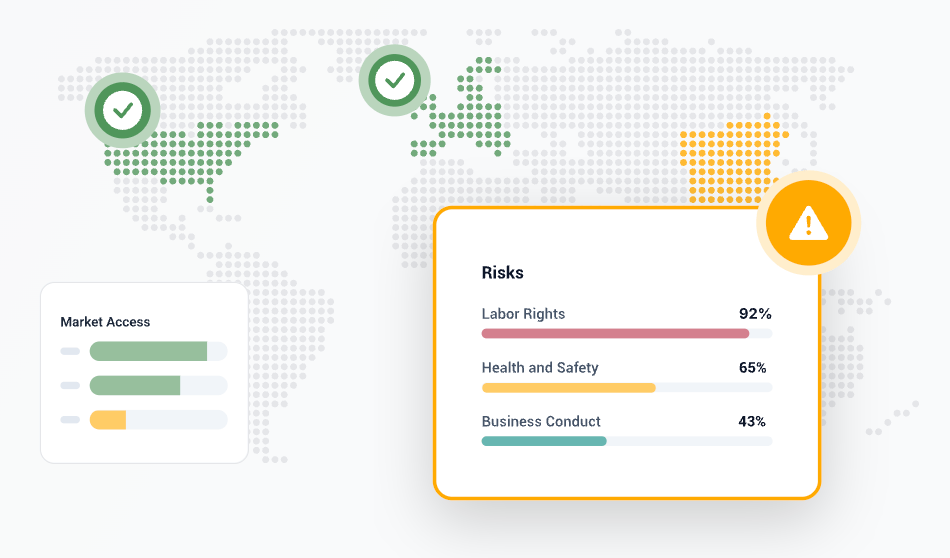
A snapshot of Assent Supply Chain Sustainability Platform | Credit: Assent
Working across thousands of suppliers and manufacturers, what patterns are you seeing in how leading companies are restructuring their supply chain data systems to move from reactive compliance to proactive risk management?
Companies leading the way in proactive risk management have one thing in common: They aren’t looking at moving regulation deadlines and assuming it means they have more time to prepare their data. They are maximizing the opportunity to build a strong foundation of accurate supply chain information to support their compliance and sustainability programs, so they aren’t ever in a reactive position again.
They’re using the time to engage and educate their suppliers on their requirements to strengthen those relationships and increase their data quality. They’re spending the time to close data gaps and verify the information from their supply chain, and leveraging AI to help. Choosing to identify and mitigate supply chain risk now versus waiting on the sidelines is what truly separates the companies that are leading the way with their supply chain sustainability management.

PARTNER WITH US

Increase your brand awareness and visibility by reaching the right audience and target market. Showcase your company, solutions, services, products, reports, surveys, events, or other content in front of our highly targeted audience of +6,500 Sustainability & ESG professionals. Contact us at arditnaka@greendigest.co if you think we can partner in some way.